Private power lines on acreage: a Penrith owner's guide to poles, lines and responsibilities
How power reaches an acreage home, what the owner is responsible for, how private poles and lines age, and the options for keeping them safe.
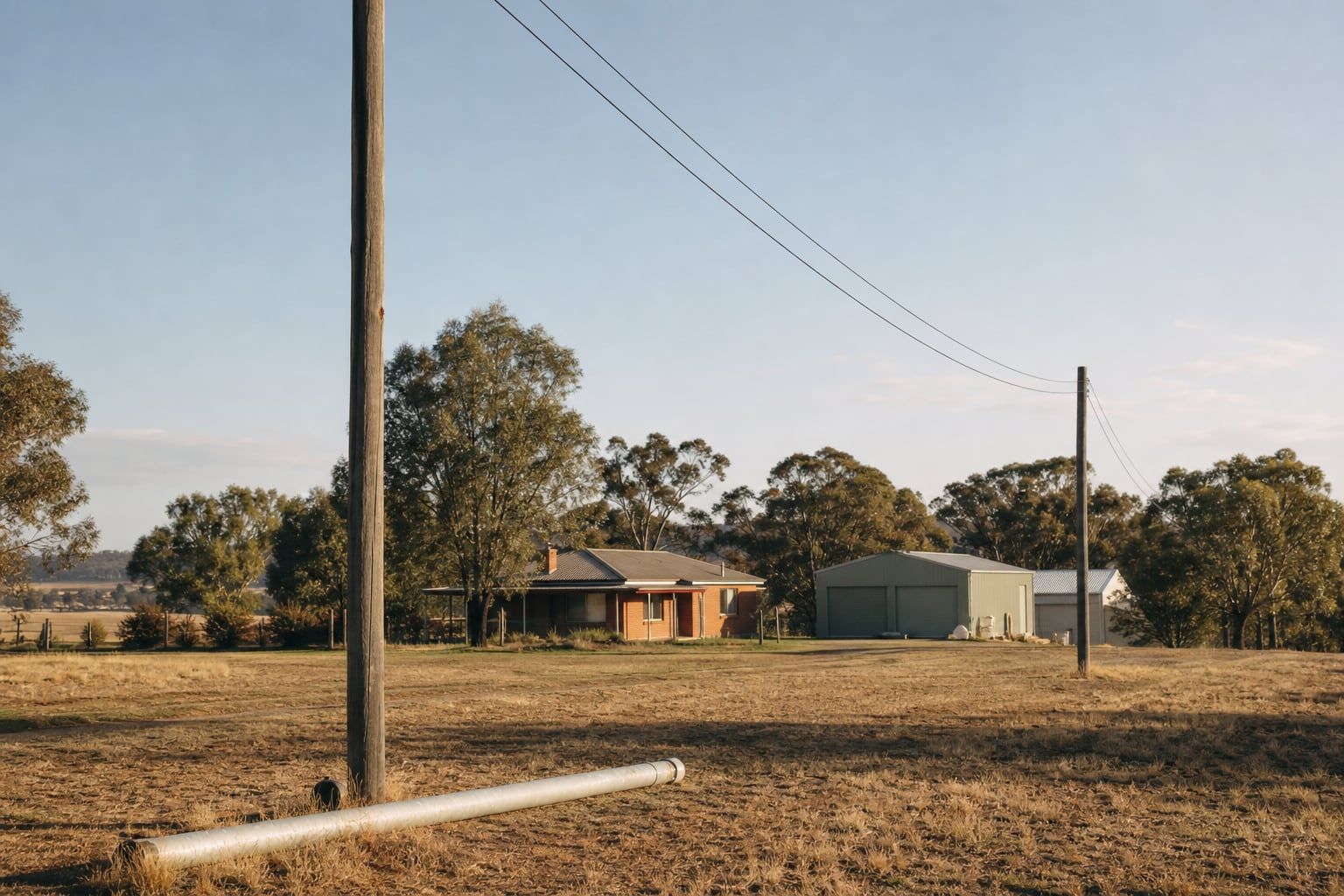
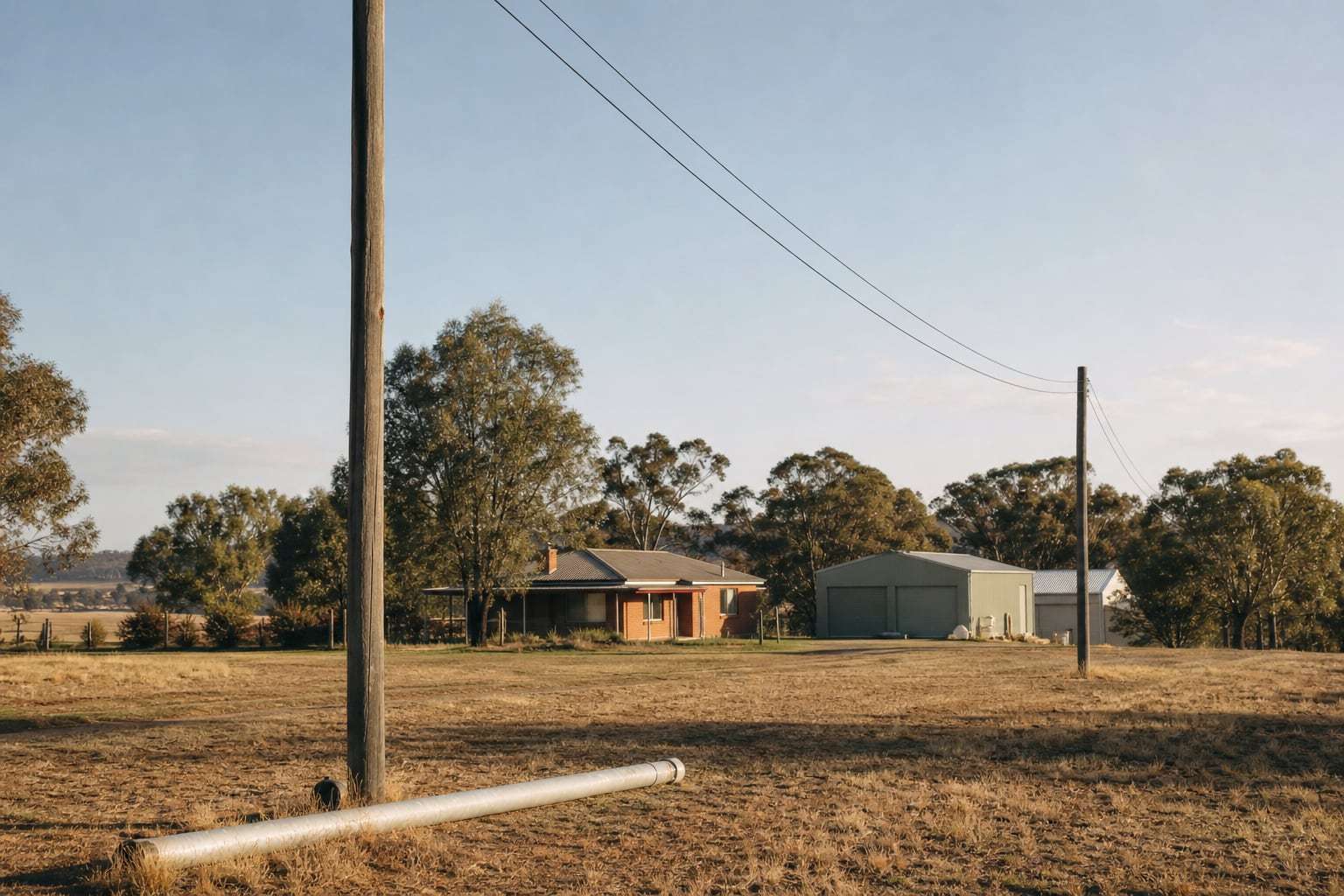
Acreage living around Penrith, in Mulgoa, Wallacia, Orchard Hills, Luddenham edges, Llandilo, Londonderry and Castlereagh, comes with space, sheds and a long driveway. It also often comes with a private electricity network: a line of poles and wires carrying power from the road to the house, and on to the shed, the pump and maybe a second dwelling. Most owners don’t think about it until a pole leans or a storm brings a line down. This guide explains what you own, what goes wrong and what to do about it.
How power reaches an acreage home
Endeavour Energy’s network runs along the road. A service connects your property to it at a connection point, usually the first pole inside your boundary or on the frontage. From there, private poles and lines carry the supply across the property. On bigger blocks there may be several spans and branches: one to the house, one to the shed, one to a pump or second dwelling.
What you’re responsible for
Everything after the connection point is the owner’s: poles, crossarms, insulators, lines and any underground cables. You’re responsible for keeping it safe, repairing it when it’s damaged and keeping trees on your land clear of it. Where a private line crosses a boundary, responsibility can be shared between neighbours.
How private lines age
Poles. Timber poles decay at ground level and just below, where moisture and oxygen meet, and termites attack the same zone. Penrith’s clay soils hold water, and poles set in concrete can trap it against the timber.
Crossarms and insulators. Timber crossarms crack and split; porcelain insulators chip and break.
Lines. Old bare or early insulated conductors can sag, stretch and corrode. Spans that were tight forty years ago may now hang close to trees, sheds or the ground.
Trees. Gums and casuarinas grow fast and drop limbs in storms and heat.
Warning signs to check
Walk the line every few months, and after storms:
- Poles leaning, or leaning more than before
- Soft, cracked or hollow-sounding timber at the base
- Termite mud on poles or nearby fence posts
- Cracked crossarms or broken insulators
- Sagging spans, or lines close to trees, sheds or the ground
- Branches touching or overhanging the lines
Don’t climb poles or touch lines. If a pole is badly leaning or a line is down, keep people and stock away and call our emergency level 2 electrician line.
Fire weather
The rural edges of Penrith City include bushfire-prone land. Private lines through dry vegetation are a fire risk if they clash in wind, sag into trees or come down. Keeping vegetation clear and replacing failing hardware before summer is the best protection.
Your options
Replace like-for-like. New treated timber poles and new fittings where needed. The quickest fix for one or two bad poles.
Change to steel. Galvanised steel poles don’t rot or feed termites. They suit termite-prone properties and last a long time.
Re-route. Moving poles or lines away from tree lines, new sheds or a planned driveway can remove a problem without replacing the whole run.
Go underground. An overhead to underground conversion replaces the whole private overhead network with cable in conduit. On a long acreage run it’s a bigger job, but it removes poles, spans, tree clearance and most storm risk for good.
Our private power pole replacement page has more on the work itself.
Adding capacity
If you’re adding a workshop, a pump, a second dwelling or an EV charger, the private line may not be big enough. Upgrading it is a good time to fix poles and spans too. If the property needs three phase, the private network has to carry three phase from the connection point.
Subdividing
When acreage is subdivided, private lines often cross the new boundaries. They usually need to be removed or re-routed as the lots are connected. Plan it early with your surveyor and builder.
A simple maintenance plan
- Walk the line twice a year and after big storms
- Keep trees clear of the lines
- Get an inspection if poles are old or you’ve never had one
- Fix problems before summer
- Keep records of work and certificates
Records
Keep a simple record of each pole, when it was installed or last inspected, and any certificates. It makes future inspections faster and helps when you sell.
Get it checked
Call the Penrith level 2 electrician team for an inspection of your private network. We’ll tell you plainly what’s sound, what’s not, and what it’ll cost to fix.
Updated
Private power lines on acreage: common questions
Something else on your mind? Call 02 9158 9998 and ask.
How can I tell where the network ends on my property?
Usually at the first pole or connection point inside your boundary. Everything after it is private. If you're unsure, we can trace it on a visit.
Can I trim trees near my private line myself?
Not if the branches are close to the line. Work near live overhead lines needs qualified people. We can isolate the line so the trees can be trimmed safely.
Is undergrounding always better?
It removes the poles and the overhead risks, but on long runs it's a bigger investment. For some properties, replacing poles with steel and re-routing away from trees is the better value.